
Query fan-out: what it is, how it is observed and how to cover the sub-queries
Contents
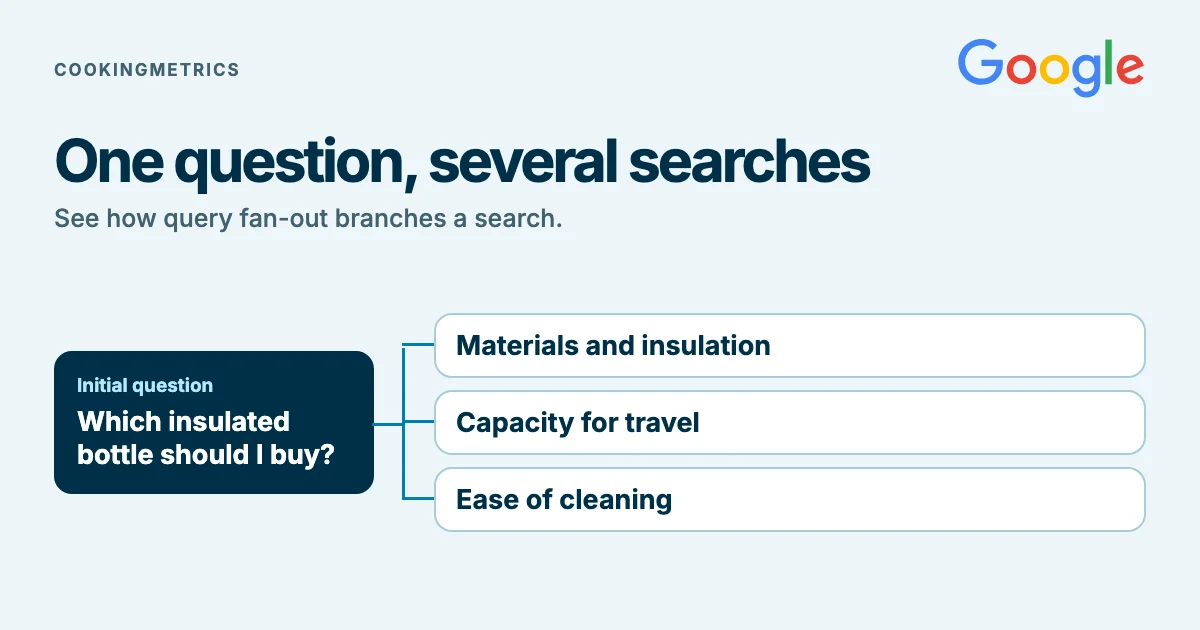
Query fan-out is the technique with which, according to Google, AI Overviews and AI Mode split a question into subtopics and launch several related searches before putting together the answer. For a content team, this means a page can compete for topics that nobody typed into the search engine. Google states that there are no additional requirements to appear; what follows are our own criteria for covering the subtopics well.
This guide is written for the people who decide what content to produce, not only for those who write it. Technical terms are explained in plain words and the detail goes under the label "For the technical team". CookingMetrics offers audits and support to development teams, and does not sell visibility tools. This guide does not promise that covering sub-queries produces citations or rankings.
In summary
- Google describes query fan-out on its own pages: splitting the question into subtopics and issuing several related searches at the same time. In the pages consulted, it does not publish how it chooses the subtopics or how many searches it issues in each case.
- A study by a content software provider (Surfer) found that the pages cited in AI Overviews tend to rank for sub-queries as well. It is a correlation published by a company that sells related products, and the study itself warns that it does not prove causality.
- That same study reports that about two thirds of the cited pages were not among the top ten results for the main query or for any sub-query. Covering subtopics does not by itself explain who gets cited.
- The sub-queries that a consumer assistant issues are not directly visible. The developer interfaces of Gemini, OpenAI and Anthropic do return the searches they made, but they are not equivalent to what AI Mode or the ChatGPT app does.
- A reasonable way to act is a subtopic map: list the subtopics of an important query, see which ones the site covers and decide whether they belong on the same page or on another one, without fragmenting.
What Google says
Google uses the expression "query fan-out" on three official pages consulted on November 12, 2026:
- March 5, 2025 (Google blog): when introducing AI Mode, it states that it uses a "query fan-out" technique that issues several related searches simultaneously, across subtopics and several data sources.
- May 20, 2025 (Google blog, I/O): it describes the same thing as splitting the question into subtopics and issuing many searches at once, and presents a feature called Deep Search that, according to the text, uses the same technique "taken further" and can issue hundreds of searches.
- Search Central documentation, "AI features and your website": it states that both AI Overviews and AI Mode may use this technique to produce an answer and that, for that reason, they may show a broader and more diverse set of links than classic search. The page does not show an update date.
The same documentation says two things that matter for making decisions:
- To appear in these features, the page must be indexed and be eligible to be shown in Google with a text snippet. The page says that there are no additional technical requirements and that no special structured data format is needed; it recommends the usual SEO practices. Appearing is not guaranteed.
- To measure, the traffic from these features is included in the total search traffic in Search Console, within the performance report, "Web" search type.
What the pages consulted do not say: how the subtopics are chosen, how many searches are made in a typical query, or whether covering subtopics increases the likelihood of being cited.
What changes for a content team
The idea is simple. A person writes a broad question; the system breaks it down into more specific questions and looks for answers to each one. A page that answers one of those specific questions well can appear even if the original query does not contain its words.
An example, illustrative and created for this guide, not an observed breakdown: given "which washing machine suits a family of four", a system might search separately for capacity in kilograms, water and energy consumption, noise level, price range and warranty. A store page that only lists models does not answer any of those questions; one that explains how to choose capacity according to household size answers one.
Two practical consequences, both CookingMetrics criteria and not Google guidance:
- It is worth knowing which subtopics matter for your business and checking whether the site answers them clearly, instead of limiting yourself to ranking for the main phrase.
- It is not worth writing a page for every imaginable subtopic. Fragmenting content to "cover" queries can worsen the reader's experience; it is a reasonable hypothesis, not guidance from Google.
Exclusive content
For signed-in readers
Compare the map with existing content
Identify coverage, contradictions, duplication, and unknown information without fabricating citation probabilities.
Sign in to access this section →We work to offer the best possible content, which is why some of these explanations are not public.
Your account does not have access to this section. Request a demo
What the studies say
The most cited reference is an article by Surfer, a content software provider, updated on October 22, 2026. What it reports, according to its own page:
- Method: 10,000 keywords; for each one, the top ten results; 76% had an AI Overview. The sub-queries, 33,000 in total, were obtained using Gemini. The page does not say that they are the ones Google actually issued.
- Results: a Spearman correlation of 0.77 between the number of sub-queries for which a page ranks and whether it is cited. 51.2% of the cited pages ranked for the main query and at least one sub-query; 19.6%, only for the main one; 29.2%, only for sub-queries. The figures of "161% more likely" and "49% more" that other blogs circulate come from those proportions; they are comparisons between proportions of cited pages, not measured probabilities.
- Finding that tends to be omitted: 67.82% of the cited pages were not among the top ten results for the main query or for any sub-query.
- Limits declared by the study itself: it is a correlation, not causality, and stronger pages tend to rank for more queries and to be cited more.
- Limits pointed out by this guide: the study comes from a provider that sells related products and does not disclose that interest in the study section. The specific study page that the article cites was not found. Country and language are not listed either.
How to read it: it is a clue, not a recipe. That cited pages rank for several sub-queries is consistent with covering subtopics helping, and also with them simply being stronger pages.
How to observe sub-queries
There is no official view that shows the sub-queries Google issued for an answer. There are three approaches, from least to most technical, and all of them are indirect.
- Search Console. It shows the queries for which your pages appeared, not the ones the system issued. The documentation consulted does not say how to separate clicks from AI Overviews and AI Mode from the rest; see how to measure traffic from AI assistants. A reasonable hypothesis, not verified, is that some long-tail queries that appear there correspond to subtopics.
- Your own team. The questions that sales and customer service receive are usually the real subtopics of a purchase decision. It is the most reliable source for the list, and it does not depend on any assistant.
- Developer interfaces. The web search tools of Gemini, OpenAI and Anthropic return the searches the model made. They are useful to see how a model breaks down a question; they are not equivalent to what happens in AI Mode or in a consumer app, and the pages consulted do not claim that they are.
For the technical team. According to the developer documentation consulted on November 12, 2026 (with no visible date on any of the three pages): in the Gemini API, the google_search_call step contains the queries executed; in OpenAI's, the search action of a web_search_call includes "normally, but not always" the queries, and the sources field lists the addresses consulted if requested with the include parameter; in Anthropic's, the server_tool_use block of the web_search tool carries the query in input. Field names may change; verify them in the current documentation.
Exclusive content
For signed-in readers
Record observations with their scope
Keep the query, context, and response without attributing internal subqueries you could not observe.
Sign in to access this section →We work to offer the best possible content, which is why some of these explanations are not public.
Your account does not have access to this section. Request a demo
A procedure: the subtopic map
A method proposed by CookingMetrics, not validated or run on our own data; it is not guidance from Google.
- Choose a main query with business value. Not all of them deserve the work.
- List the subtopics. Start from real customer questions; add the Search Console queries for the page and, if desired, a sample of what a developer interface returns.
- Mark which ones the site covers today and with which page, with one sentence per subtopic. If no page answers it, it is a gap.
- Decide where each gap goes. If the subtopic has an intent of its own and someone could arrive directly at it, it may deserve its own page; if it is a step within the same decision, a section with a clear heading on the main page is usually enough.
- Link and record. Link between the related pages, note the date and look again in Search Console at 8-12 weeks. What changes may be due to many causes; it is not attributed to the map.
Exclusive content
For signed-in readers
A map applied to a purchase decision
Organize needs, questions, sources, and responsible pages in a fictional ecommerce example.
Sign in to access this section →We work to offer the best possible content, which is why some of these explanations are not public.
Your account does not have access to this section. Request a demo
One page or several
Editorial criterion, with no backing from Google:
- One page when the subtopics are steps of the same decision and the reader wants them together.
- Several pages when each subtopic has a different intent and enough content of its own to be useful.
- Avoid nearly identical pages that change one word, and thin pages created only to "cover" a query.
Exclusive content
For signed-in readers
One page or several: a resolved case
Compare what belongs together and what merits its own page based on the reader’s task.
Sign in to access this section →We work to offer the best possible content, which is why some of these explanations are not public.
Your account does not have access to this section. Request a demo
What not to conclude
- That covering sub-queries produces citations. The cited study is a correlation from a provider.
- That a breakdown obtained with a developer interface is the one Google makes.
- That there is a correct number of subtopics per page. No source consulted gives one.
- That query fan-out replaces the usual SEO practices. Google states that there are no additional requirements.
What to do next
For a practical way to apply the topic map, see how to find content opportunities in Search Console.
Choose an important query for your business and build the subtopic map with your customers' real questions. If you would like us to review what your site covers today and how to measure it, learn about our SEO for AI search service: we review and support your team, and we do not sell visibility tools. For the general framework, see what GEO is.
Frequently asked questions
What is query fan-out?
It is the technique that Google describes for AI Overviews and AI Mode: splitting a question into subtopics and issuing several related searches before producing the answer.
Is anything special needed to appear in AI Overviews or AI Mode?
According to Search Central, there are no additional requirements: the page must be indexed and be eligible to be shown with a text snippet. Appearing is not guaranteed.
Can the sub-queries that were made be seen?
Not in AI Mode or in AI Overviews, according to the documentation consulted. The developer interfaces of Gemini, OpenAI and Anthropic return the model's searches, which are not equivalent to those of those products.
Is it true that covering sub-queries makes a page 161% more likely to be cited?
That figure comes from a study by a software provider and summarizes a comparison between proportions of cited pages. The study itself says it is a correlation and not causality.
Is it worth creating a page for every subtopic?
Not necessarily. If the subtopic is a step in the same decision, a clear section within the page may be enough; if it has an intent of its own, it may deserve its own page.